
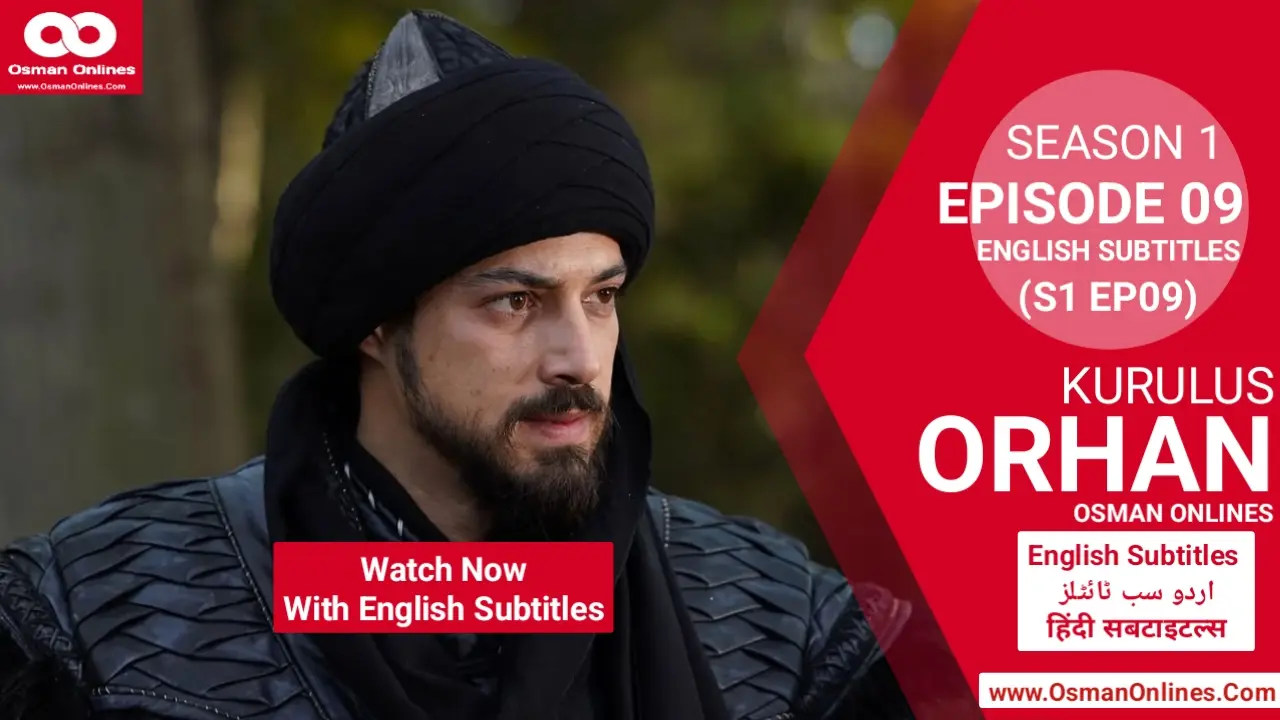
Kurulus Orhan Season 1 Episode 9 with English Subtitles
Kurulus Orhan Season 1 Episode 9 with English Subtitles
“Niyetim ve arzum Tanrı’yı memnun etmektir.”
My intention and desire are to please God.
This powerful declaration sets the spiritual and moral foundation of Kurulus Orhan Season 1 Episode 9 With English Subtitles, an episode that moves beyond action and into the deeper realms of faith, loyalty, love, and political foresight. Episode 9 stands out not merely as a continuation of conflict but as a turning point where every character is tested by conscience as much as by the sword.
Set against the volatile frontier between Turkic beyliks and Byzantine authority, the episode carefully balances emotional drama with strategic warfare, revealing how personal choices shape the fate of nations.
The Trap Laid for Princess Asporça: Faith Versus Deception
The episode opens with a calculated ambush. The Holy Templar Knights, acting through covert alliances, lay a deadly trap for Princess Asporça. This is not a random attack; it is a politically motivated assassination designed to destabilize alliances and ignite chaos.
Orhan Bey’s Intervention
Orhan Bey’s swift action disrupts Hector’s meticulously planned assault. By rescuing Asporça, Orhan does more than save a life he exposes the fragility of Byzantine intrigue when confronted by principled leadership.
Italic emphasis: Orhan Bey does not act for reward or praise; his actions stem from duty and faith.
Yet, paradoxically, this rescue intensifies Asporça’s anger. To her, survival comes at the cost of pride, autonomy, and political leverage.
Why Asporça’s Anger Matters
Asporça’s fury is not mere arrogance. It reflects:
- Her struggle to maintain authority
- Her distrust of Turkic leadership
- Her fear of becoming a pawn rather than a queen
This emotional complexity adds depth to the episode, transforming a rescue into a catalyst for conflict.
Rising Tension in the Camp: Asporça and Orhan Bey
Asporça becomes an unwilling guest in Orhan Bey’s camp. The environment is unfamiliar, the rules are foreign, and her status is uncertain.
A Clash of Worldviews
| Aspect | Orhan Bey | Princess Asporça |
|---|---|---|
| Leadership Style | Faith-based, collective | Power-driven, imperial |
| Motivation | Justice and unity | Survival and dominance |
| Trust | Earned through actions | Guarded through control |
Orhan Bey’s decision to keep Asporça in the camp raises questions even among his own people. Is this mercy or strategy?
Nilüfer Hatun and Princess Asporça: A Conflict of Strength
The tension reaches a new level when Nilüfer Hatun witnesses the growing hostility. Unlike Asporça, Nilüfer represents inner strength rooted in belief, restraint, and loyalty.
Two Powerful Women, Two Paths
- Asporça symbolizes political survival through dominance
- Nilüfer Hatun embodies moral authority and emotional resilience
Their looming conflict is not merely personal it reflects a broader struggle between imperial ambition and emerging Turkic identity.
Strength is not always loud; sometimes it stands firm in silence.
This unspoken rivalry threatens to disrupt the fragile balance within the camp.
Orhan Bey’s True Objective: Hector
Behind every visible conflict lies a deeper strategy. Hector, operating from the shadows, remains Orhan Bey’s true target.
Strategic Patience Over Rash Action
Orhan Bey does not rush into confrontation. Instead, he:
- Allows Hector to overextend his schemes
- Uses misinformation to his advantage
- Observes Byzantine reactions carefully
This calculated restraint showcases Orhan Bey’s evolution from warrior to statesman.
Expected Byzantine Response
Orhan’s maneuvering forces the Byzantine side into uncertainty. Power struggles intensify as Hector’s authority is questioned, proving that strategic pressure can be more destructive than open warfare.
Hector’s Revenge: Flavius Given a Deadly Order
Hector’s rage over losing Orhan Bey’s control manifests in a chilling command. He orders Flavius to kill in the name of the Holy Templar Knights.
A Moral Dilemma
The target of this order places Flavius in an unbearable position Fatma Hatun.
Flavius is torn between:
- Loyalty to the Knights
- Love for Fatma Hatun
- His own conscience
This subplot introduces one of the episode’s most human struggles.
| Choice | Consequence |
|---|---|
| Obedience | Loss of love and humanity |
| Defiance | Death, betrayal, and exile |
Italic reflection: When love and loyalty collide, the soul becomes the battlefield.
Love Versus Allegiance: The Cost of Choice
Flavius and Fatma Hatun’s relationship highlights how personal bonds challenge rigid hierarchies. Their reunion is charged with emotion, danger, and irreversible consequences.
The episode does not romanticize their love. Instead, it presents love as:
- A source of strength
- A cause of vulnerability
- A test of moral courage
Their fate remains uncertain, but the emotional weight reshapes the narrative landscape.
Halime and Dursun: Love Born in Exile
Away from palaces and battlefields, Halime and Dursun face exile after being driven from their village.
A Quiet Yet Powerful Arc
Their story unfolds through dialogue rather than action. In exile, truths surface.
Key themes in their journey:
- Emotional honesty
- Shared suffering
- The possibility of reunion
Will their love find words or remain unspoken? Their fate mirrors the uncertainty faced by countless displaced souls in frontier societies.
Osman Bey’s Dream: The Flag Over Bursa
While Orhan Bey confronts immediate threats, he also carries his father’s vision.
Osman Bey’s dream is clear:
To see the Kayı flag flying over Bursa.
From Dream to Strategy
Orhan Bey begins laying the groundwork:
- Securing alliances
- Weakening enemy logistics
- Preparing ideological unity, not just military conquest
This is not conquest for glory it is nation-building.
Empires are not built only by swords, but by patience, belief, and vision.
Watch Kurulus Orhan Season 1 Episode 9 with English Subtitles
SOURCE 1:
Why Trailer 3 Matters in the Series Structur
Historical Context: Faith as Political Identity
Kurulus Orhan continues its tradition of blending historical reality with dramatic storytelling. Episode 9 reinforces how faith functioned as:
- A moral compass
- A unifying ideology
- A legitimizing force for leadership
The emphasis on intention (niyet) reflects authentic Turkic-Islamic governance philosophy of the era.
SOURCE 2:
Key Takeaways from Episode 9
- Orhan Bey’s leadership is defined by restraint and foresight
- Asporça’s anger stems from political vulnerability, not weakness
- Nilüfer Hatun represents silent authority
- Hector’s power relies on fear, making it unstable
- Flavius faces the ultimate moral test
- Love stories enrich the historical narrative
- Osman Bey’s dream moves closer to reality
SOURCE 3:
Conclusion: An Episode of Inner Battles and Greater Visions
Kurulus Orhan Season 1 Episode 9 With English Subtitles is not merely about ambushes or confrontations. It is an episode where intentions matter as much as actions, and where every character is forced to confront who they truly are.
Through faith-driven leadership, emotional conflict, and long-term vision, Episode 9 deepens the series’ historical and philosophical core. The path to Bursa is not yet complete but the foundations are being laid, step by deliberate step.
Frequently Asked Questions (FAQ)
Yes. While dramatized, the episode reflects real political tensions, ideological struggles, and leadership philosophies of early Ottoman history.
Her anger arises from wounded pride, political insecurity, and fear of losing control over her destiny.
Rather than direct confrontation, Orhan Bey focuses on destabilizing Hector through patience, intelligence, and moral authority.
No. It balances strategy, emotional arcs, love stories, exile, and spiritual themes.
Faith shapes leadership decisions, personal morality, and the legitimacy of power throughout the episode.