
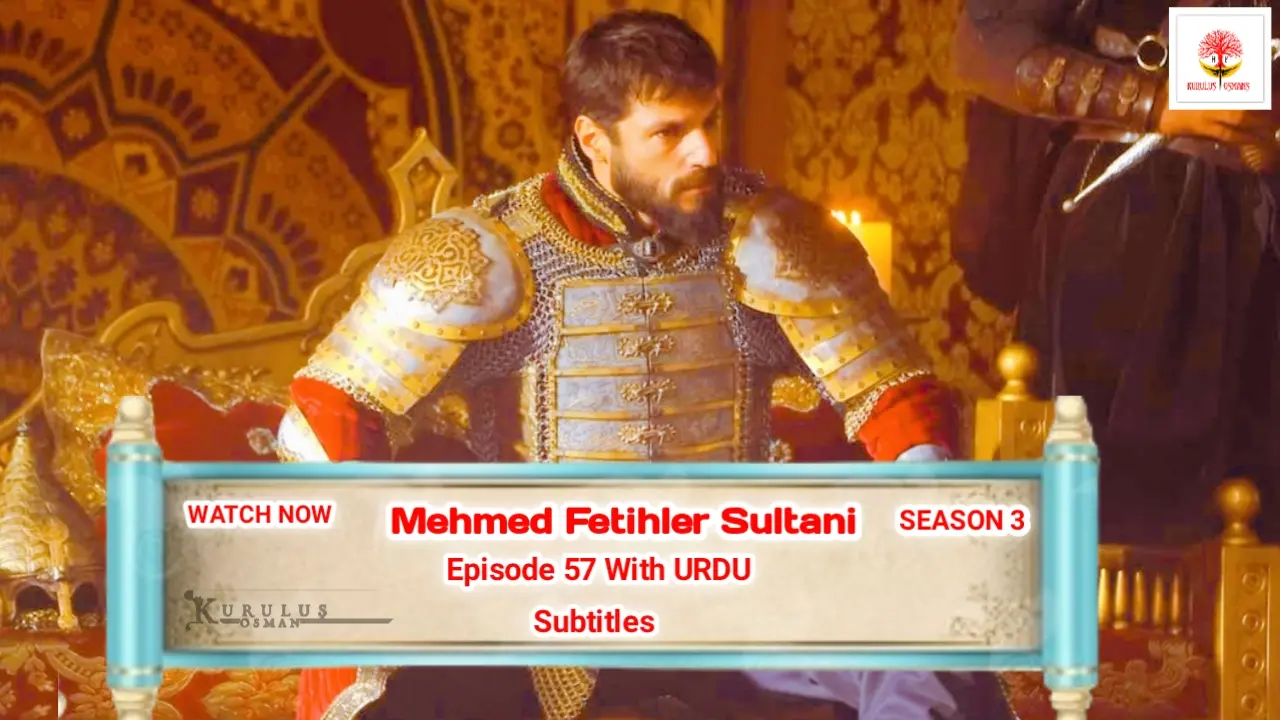
Mehmed Fetihler Sultani Season 3 Episode 57 With Urdu Subtitles
Mehmed Fetihler Sultani Season 3 Episode 57 With Urdu Subtitles
The Mehmed Fetihler Sultani Season 3 Episode 57 With Urdu Subtitles delivers an emotionally charged and politically intense continuation of Sultan Mehmed’s journey. The episode unfolds a gripping narrative woven with deception, sacrifice, and the silent storms of power. Episode 57 stands out for its intricate storytelling that combines historical truth with deep moral questions about justice, loyalty, and the heavy burden of leadership.
The Assassination Attempt and the Seeds of Suspicion
The episode opens with shocking news: an assassination attempt on Mahmud Pasha shakes the foundations of Mehmed’s court. In the chaos that follows, Basat’s tragic death adds fuel to the fire. Bloodstains, suspicious testimonies, and unclear motives lead everyone’s attention toward one figure Vlad Tepes, the infamous Wallachian ruler known for his ruthlessness.
Despite overwhelming suspicion, Sultan Mehmed chooses reason over impulse, releasing Vlad due to insufficient evidence. This decision, however, does not sit well with his commanders. The halls of power are filled with whispers of betrayal, and Mehmed’s silence becomes more unsettling than any accusation.
The Struggle for Justice: Zeynel’s Fate and Kurtçu Doğan’s Courage
In a parallel thread, Orta Ağa Zeynel faces punishment for his alleged misconduct. Yet, before the sentence can be carried out, Janissary Ağa Kurtçu Doğan steps forward, risking his own life in defense of justice. His sacrifice strikes a deep chord within Mehmed, who pardons Zeynel. This moment showcases the Sultan’s capacity for mercy and his respect for courage.
But Kurtçu’s doubts linger. He cannot ignore the inconsistencies in Vlad’s actions that night. His silent investigation begins to unravel a darker truth hidden behind the walls of loyalty and deceit.
Vlad’s Return: The Hero’s Facade
Just as the truth threatens to emerge, Vlad returns from Pontus with a stunning victory. The relic he brings back a symbol of faith and triumph and the captive he rescues elevate his image in Mehmed’s eyes. The Sultan calls him “brother,” binding him with the chain of trust.
Yet, the wolfman’s silence his quiet, observing demeanor hides a dangerous secret. The narrative leaves viewers in suspense: is Vlad a loyal ally, or a lurking threat cloaked in honor?
Bayezid’s Moral Conflict in Constantinople
Meanwhile, in Constantinople, Prince Bayezid faces his own moral storm. A plot to assassinate him, orchestrated by Kasım Bey, the father of Gülperi, is exposed. The emotional weight of betrayal crushes Bayezid’s spirit. Instead of vengeance, he chooses mercy a decision that defines his character and contrasts sharply with the ruthless politics surrounding him.
Bayezid’s act of forgiveness is not just a personal triumph; it’s a reflection of Mehmed’s own philosophy power must always be tempered by conscience.
The Ottoman Campaign and the Shadow of War
The second half of the episode shifts to grand strategy. Sultan Mehmed commands a campaign against İsfendiyaroğlu, determined to protect the empire’s unity. But far from the capital, Pontus Emperor Komnenos rallies Draven to ambush the Ottoman army from behind.
The battle drums of Pontus echo against Mehmed’s silence. The Sultan’s calm demeanor conceals a storm of plans a chess master preparing his final move. His decisions are not shouted but whispered, and every silence hides a command.
Symbolism of the Sword and the Silence
One of the episode’s most poetic lines resonates deeply:
“The sword is in the sheath, the command is in the tongue.”
This phrase embodies the Sultan’s leadership style. His restraint is his greatest strength; his silence, his sharpest weapon. Episode 57 captures this duality perfectly the calm before history’s greatest storms. Mehmed’s quiet determination stands as a metaphor for calculated power and the timeless wisdom of a ruler who leads not through fear, but through vision.
Key Relationships and Political Tensions
| Character | Role in Episode 57 | Key Action | Impact |
|---|---|---|---|
| Sultan Mehmed | Leader of the Ottoman Empire | Pardons Vlad; commands new campaign | Shows wisdom and restraint |
| Vlad Tepes | Suspicious ally | Returns victorious with relic | Earns trust but hides truth |
| Mahmud Pasha | Loyal vizier | Survives assassination attempt | Catalyst for new suspicions |
| Kurtçu Doğan | Brave Janissary Ağa | Defends justice at own risk | Symbol of loyalty |
| Bayezid | Mehmed’s son | Chooses mercy over revenge | Embodies moral strength |
| Kasım Bey | Gülperi’s father | Plots assassination | Exposed and disgraced |
Leadership Under Fire: Mehmed’s Silent Strategy
Every great ruler faces a test of faith. For Mehmed, that test comes not from enemies on the battlefield but from the shadows within his court. His restraint in the face of chaos reveals his understanding that power lies not in the sword, but in patience.
By sparing Vlad and Zeynel, Mehmed risks appearing weak yet this is a deliberate act of control. His silence becomes a mirror in which the guilty see themselves. Episode 57 portrays Mehmed as a strategist who knows that “true conquest begins within.”
Watch Mehmed Fetihler Sultani Season 3 Episode 57 With Urdu Subtitles
Source 1:
Historical Echoes and Cinematic Excellence
“Mehmed Fetihler Sultani Season 3 Episode 57 With Urdu Subtitles” doesn’t just dramatize history; it revives it with emotional intensity. The cinematography reflects the dual nature of war and peace — the flicker of torchlight in dark corridors, the solemn silence before battle, and the haunting score that underscores Mehmed’s internal struggles.
The episode’s direction balances political intrigue and philosophical depth, making it one of the most layered episodes of the season. Every scene, from the tension-filled council meetings to Bayezid’s quiet reflection, adds texture to Mehmed’s evolving legacy.
Source 2:
Key Takeaways
- Trust and betrayal form the central theme of the episode.
- Vlad Tepes’s dual nature creates suspense and unpredictability.
- Sultan Mehmed’s silence symbolizes discipline, control, and foresight.
- Bayezid’s forgiveness mirrors his father’s inner strength.
- The Ottoman campaign sets the stage for future conflicts and alliances.
Conclusion
Episode 57 of Mehmed Fetihler Sultani Season 3 captures the perfect blend of human emotion and imperial destiny. It teaches that empires rise not by conquest alone but by the wisdom to hold one’s sword when anger tempts the hand. The Sultan’s silence is not weakness it is command.
As the episode closes, Mehmed stands once again at the threshold of history, his eyes fixed on the horizon. The silence around him hums with destiny, for the next move he makes will not only shape the fate of his empire but also echo across centuries.
Frequently Asked Questions (FAQ)
The episode centers on trust, leadership, and the moral weight of decision-making, showcasing Mehmed’s brilliance and restraint amidst internal conflict.
While Vlad Tepes is suspected, the episode leaves the truth shrouded in mystery, setting up intrigue for upcoming episodes.
It represents both divine favor and manipulation a symbol of faith twisted into a political weapon.
The episode’s ending hints at a major Ottoman campaign and unresolved tensions that will erupt in the following episodes.
Mehmed Fetihler Sultani Season 3 Episode 57 With Urdu Subtitles is more than a continuation it’s a study of the human spirit under power’s weight. It reminds viewers that history’s greatest rulers are not those who conquer lands, but those who conquer themselves.